1

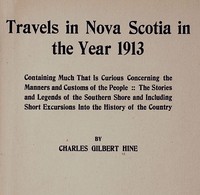
Travels in Nova Scotia in the Year 1913 — Background and Themes
(0 User reviews)
1576
Project Gutenberg
2021
Not confirmed
Nova Scotia -- Description and travel
Readers of public-domain and historical texts
Project Gutenberg digital edition
en
Edition facts
Words
24,541
Reading time
107 min
Text sections
16
The source record for Travels in Nova Scotia in the Year 1913 — Background and Themes measures this digital text at 24,541 words, 1 hr 47 min estimated reading time, and 16 detected text sections.
The text analysis averages about 26.9 words per sentence, while the detected sections provide another way to judge how the source is divided.
Project Gutenberg metadata also associates the work with “Nova Scotia -- Description and travel,” connecting these edition facts with the source record’s subject description.
Source:
Project Gutenberg record #66126
Charles Gilbert Hine's 1913 travelogue blends wry self-deprecation, precise observation of Nova Scotia's south coast, and a playful mock-heroic tone. His narrative voice shifts from lyrical descriptions of misty landscapes to deadpan encounters with locals, all while documenting a region on the cusp of change.
Editorial Edition Score
4.7/5
★★★★★
★★★★★
Calculated from edition completeness, EPUB availability, text structure and catalogue metadata. Not a user rating.
How this score is calculated
- Description quality20 pts
- Title & short description10 pts
- Source metadata20 pts
- Text length15 pts
- Chapters / structure15 pts
- EPUB file integrity20 pts
Total of 100 points, scaled to a 2.5-5.0 range. Editions with an empty description or a missing EPUB file are not scored.
Edition quality
Read the Text
d notions, and he concluded to see another doctor, who advised, “For a few days before you go eat sparingly, almost starve yourself.” Wholly at sea now, he called in a third man of medicine, who stated, “Both are right; it depends entirely on whether you wish to discard from strength or weakness.” I went to neither extreme myself and, the sea being calm, suffered no harm.
The only real fault I have to find with this trip is that too much was attempted. Yarmouth to Halifax does not look like a great distance on the map, and consequently I looked up the story of that section, to discover so many items of interest strewn along the deep indentations of this rugged coast that it seemed highly improper to allow any to pass by unobserved. But while a straight line between the two points is not appalling, to follow the coast line is much like attempting a trip from the Hudson at Forty-second street to the opposite point on the East River by way of the Battery.
I doubt the wisdom of one in my frame of mind spending an entire day in one town--it was the open road that beckoned. But a day had been set apart for Yarmouth, and as this particular one was never intended for such a pleasure exertion as mine, owing to its moist condition, it seems probable that I had planned better than I knew.
The history of Yarmouth appears to have been rather uneventful, but the public library contains an interesting relic of prehistoric times in a runic stone discovered on the west side of the harbor about 1815 by a Doctor Fletcher, and which the antiquarians after much labor have translated as “Harko’s son addressed the men.” The records show that in 1007 the Norsemen made an expedition along this coast, and one Harki is mentioned therein, and this and a somewhat similar stone found in the same general locality in 1897 are supposed to commemorate some important event of that trip. Nothing more is known. The stones when discovered were lying face down in the mud; but for this the action of the elements would have effaced the lettering during the nine hundred years that have passed since the work was done.
I called on J. Bond Gray, Secretary of the Tourist Committee of the Yarmouth Board of Trade, with whom some previous correspondence had been held, and on his advice covered the first nineteen miles, to Argyle, by rail. Mr. Gray was courteous and pleasant, but in this he but follows the custom of the land where courtesy is as much a matter of course as is the glacial boulder. While on this subject I cannot overlook A. L. Nickerson, station agent. I unfolded to him my great and consuming desire for a timetable, as I expected to fall back on the railroad with more or less frequency. He had none, but appreciating the situation, said he would do what he could, and during the day he telegraphed to headquarters in the expectation of receiving a copy. That he was not successful was no fault of his, and as a last resort he made a suggestion that enabled me to secure a copy at another point. This proved to be the almost universal spirit of the people throughout the excursion.
The walking actually began on October 14th. The rain had made desperate efforts during the greater part of the preceding night to wash Nova Scotia off the map, and when I alighted from the train at Argyle at 7:54, the morning was still highly charged with moisture. To the great wonderment of a gentleman who was spending a quiet hour with the depot stove I harnessed up and, throwing a rubber cape over my shoulders, set forth.
Once out in the storm the experience was more than pleasant. The smell of the fresh dampness was delicious, and there was a certain exclusiveness in having the highway all to one’s self that was far from unattractive, while the cleansing which the wayside foliage had undergone made even the frost-bitten ferns a rich, warm brown.
Of the entire distance to Pubnico, ten miles, the spot that best pleased my eye is to be located by the first church steeple after leaving the Argyle station. The small settlement lies close upon the water at the head of an inlet filled with beautiful little islands. But all the way through Lower Argyle the eye is filled with Argyle Sound and its many islets.
Charles Gilbert Hine opens his 1913 travelogue with a mock-heroic subtitle promising “Perilous Adventures and Marvelous Escapes,” yet the first chapter finds him aboard the steamer Governor Cobb, fretting about rain. This playful gap between grand claim and mundane reality sets the tone for a narrative that constantly undercuts its own heroics. Hine’s voice is self-aware, even ironic: he describes himself as “seemingly well versed in the art of placing one Foot before the other.” The reader quickly learns that the real adventure lies not in danger but in the patient, often wet, observation of coastal life.
A Voice That Shifts Between Lyricism and Deadpan
Hine’s prose moves abruptly from poetic landscape description to blunt, almost journalistic record. In one passage he watches “the more distant trees were the ghosts of trees, while those at hand, a dark, somber mass of green, stood strong against the misty background.” A few lines later he notes matter-of-factly that a rabbit “hopped across the road in a leisurely fashion that made it perfectly evident he was aware that I had no gun.” This tonal whiplash is deliberate: Hine refuses to settle into a single register. He can wax lyrical about “long fingers” of water reaching into the land, then undercut the mood with a wry aside about a cranky motor boat that “balked, as is the habit of these descendants of the mule.” The effect is a narrative voice that feels both intimate and unreliable, as if the author is constantly winking at his own pretensions.
Pace as a Reflection of the Journey’s Rhythm
The book’s pace mirrors the actual travel: slow, interrupted, and subject to weather. Hine lingers in Port Medway for several pages, describing the village layout, the two girls who capture his heart, and the cost of board ($5 per week). Then he compresses a ferry crossing into a single paragraph. The rhythm is not uniform; it accelerates during transit and decelerates during encounters. When Hine meets Jason Conrad and his ox cart, the narrative pauses for a life story that the author admits he failed to record fully. These digressions are not digressions at all—they are the point. The reader experiences time as Hine does: sometimes rushing, sometimes stalled by a broken engine or a talkative local. The chapter headings themselves—Port Latour and Burchtown, Shelburne and the Road to East Jordan—suggest a journey of discrete, uneven segments rather than a smooth itinerary.
Recurring Details That Anchor the Narrative
Three motifs recur with enough frequency to become structural anchors: rain, cameras, and the failure of mechanical things. Jupiter Pluvius, the rain god, is invoked in the subtitle and reappears throughout; Hine’s hopes “revived” when the afternoon ran dry, only to be dashed again. The camera is a constant companion, but it “mostly failed in its good intent,” unable to capture the misty landscape. Motor boats and engines are described as “cranky” or “loose-jointed,” requiring patience and perseverance. These repeated failures—of weather, of technology, of the author’s own memory—create a running joke about the impossibility of a perfect travel record. Yet Hine persists, and his persistence becomes the real subject. The reader is left with the impression that the journey’s value lies not in what was accomplished but in what was endured and observed along the way.
Readers should approach this book as a deliberately imperfect record. Hine’s voice is that of a traveler who knows he cannot capture everything and is honest about his limitations. Pay attention to the gaps—the stories he forgot, the photographs that failed—because they reveal as much as the successes. The book rewards those who enjoy a narrator who is both observant and self-deprecating, and who find pleasure in the slow, wet, meandering pace of a journey that never quite lives up to its heroic subtitle.
Reading Hine’s dry humor about Nova Scotia’s fog reminded me of a rainy afternoon spent with Travels Into Bokhara (Volume 1 of 3) Being the Account of A Journey from India to Cabool, Tartary, and Persia; Also, Narrative of a Voyage on the Indus, From the Sea — Story, Setting & Ideas—both travelers shrug at absurdity, yet their quiet awe for foreign skies lingers long after the page turns.
There are no reviews for this eBook.
There are no comments for this eBook.
Reader reflection
What did you think of this book?
Answer a few questions and save a private reflection on this device.
Your progress
0
/
10
2
Did this book hold your interest?
3
Would you pass this book on to a friend?
4
How much effort did this book require?
5
Was the book what you thought it would be?
6
Did you gain anything practical from the text?
7
How clearly were the main ideas presented?
8
How closely did the book connect with your experience?
9
What did this book teach you most?
10