1

An Historical Relation of the Island Ceylon in the East Indies Together with an Account of the Detaining in Captivity the Author and Divers other Englishmen Now — Background and Themes
(0 User reviews)
285
Project Gutenberg
2004
Not confirmed
Sri Lanka -- Social life and customs; Sri Lanka -- Description and travel -- Early works to 1800
Readers of public-domain and historical texts
Project Gutenberg digital edition
en
Edition facts
Words
129,828
Reading time
565 min
Text sections
15
This digital edition of An Historical Relation of the Island Ceylon in the East Indies Together with an Account of the Detaining in Captivity the Author and Divers other Englishmen Now — Background and Themes is described by source-level measurements including 129,828 words, 9 hr 25 min estimated reading time, and 15 detected text sections.
The text analysis averages about 21.3 words per sentence, while the detected sections provide another way to judge how the source is divided.
Project Gutenberg metadata also associates the work with “Sri Lanka -- Social life and customs,” connecting these edition facts with the source record’s subject description.
Source:
Project Gutenberg record #14346
Robert Knox's 1681 account of nearly twenty years' captivity in Ceylon, blending ethnographic observation with personal narrative. The opening excerpts establish his credibility through endorsements from the East India Company and Christopher Wren, while later sections detail Sinhalese dress, adornment, and domestic life with a mix of admiration and cultural bias.
Editorial Edition Score
4.9/5
★★★★★
★★★★★
Calculated from edition completeness, EPUB availability, text structure and catalogue metadata. Not a user rating.
How this score is calculated
- Description quality20 pts
- Title & short description10 pts
- Source metadata20 pts
- Text length15 pts
- Chapters / structure15 pts
- EPUB file integrity20 pts
Total of 100 points, scaled to a 2.5-5.0 range. Editions with an empty description or a missing EPUB file are not scored.
Edition quality
Read the Text
Writing was known, then known to a few, and made use of by fewer, and fewest employed it to this purpose. Add to this, that such as were written, remain'd for the most part Imprison'd in the Cells of some Library or Study, accessible to a small number of Mankind, and regarded by a less, which after perished with the Place or the Decay of their own Substance. This we may judge from the loss of those many Writings mentioned by Pliny and other of the Ancients. And we had yet found fewer, if the Art of Printing, first Invented about 240 years since, had not secured most that lasted to that time. Since which, that Loss has been repaired by a vast number of new Accessions, which besides the Satisfaction they have given to Curious and Inquisitive Men by increasing their Knowledge, have excited many more to the like Attempts, not only of Making but of Publishing also their Discoveries. But I am not ignorant still; that as Discoveries have been this way preserved, so many others nave been lost, to the great Detriment of the Publick. It were very desirable therefore that the Causes of these and other Defects being known, some Remedies might be found to prevent the like Losses for the future. The principal Causes I conceive may be these;
First, The want of sufficient Instructions (to Seamen and Travellers,) to shew them what is pertinent and considerable, to be observ'd in their Voyages and Abodes, and how to make their Observations and keep Registers or Accounts of them.
Next, The want of some Publick Incouragement for such as shall perform such Instructions.
Thirdly, The want of fit Persons both to Promote and Disperse such Instructions to Persons fitted to engage, and careful to Collect Returns; and Compose them into Histories; by examining the Persons more at large upon those and other Particulars. And by separating what is pertinent from what is not so, and to be Rejected; who should have also wherewith to gratifie every one according to his Performances.
Fourthly, The want of some easie Way to have all such Printed: First singly, and afterwards divers of them together. It having been found that many small Tracts are lost after Printing, as well as many that are never Printed; upon which account we are much oblig'd to Mr. Haclute and Mr. Purchas, for preserving many such in their Works.
Fifthly, The want of taking care to Collect all such Relations of Voyages and Accounts of Countries as have been Published in other Languages; and Translating them either into English, or (which will be of more general use) into Latin, the learned Language of Europe. There being many such in other Countries hardly ever heard of in England.
The Difficulties of removing which Defects is not so great but that it might easily fall even within the compass of a private Ability to remove, if at least Publick Authority Would but Countenance the Design, how much less then would it be if the same would afford also some moderate Encouragement and Reward?
The Royal Society of London for Improving Natural Knowledge, has not been wanting in preparing and dispersing Instructions to this end, and is ready still to promote it, if the Publick would allow a Recompence to the Undertakers. The desirableness and facility of this Undertaking may, I hope, in a short time produce the Expedients also. In the Interim all means should be used, to try what may be obtain'd from the Generosity of such as have had the Opportunities of knowing Foreign Countries.
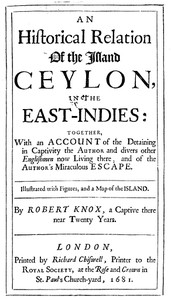
Robert Knox's An Historical Relation of the Island Ceylon opens not with his own voice but with a cluster of endorsements: a commendatory poem, a certificate from the East India Company attesting to his 'Truth and Integrity,' and a letter from Christopher Wren praising the manuscript as 'new' and 'little known.' These paratexts frame the work as a credible, valuable account—a strategy that signals Knox's need to establish authority after two decades of captivity. The title page itself announces a 'miraculous escape,' promising adventure alongside ethnography.
The excerpts that follow reveal a text that oscillates between precise observation and frank cultural judgment. Knox describes Sinhalese women's ornaments—silver bracelets, rings, ear ornaments—with ethnographic care, yet calls their stretched earlobes 'a great deformity.' This tension between recording and evaluating runs through the work, inviting readers to weigh his descriptions against his biases.
Credibility and Captivity
The prefatory matter establishes Knox as a trustworthy witness before he narrates a single event. The East India Company's committee, having 'perused in Manuscripts,' declares him 'a Man of Truth and Integrity.' Wren, a founding figure of the Royal Society, adds his weight: the account 'seems to be Written with great Truth and Integrity.' These endorsements are not mere formalities; they respond to the inherent skepticism a captive's tale might face. Knox himself, in his dedication, calls his book 'the whole Return I made from the Indies after Twenty years stay there,' framing the text as his sole material gain. Readers should note how this apparatus shapes expectations: the narrative that follows is presented as both personal testimony and scientific report, a dual identity that persists throughout.
Dress and Adornment as Social Text
Knox's description of Sinhalese women's attire in Chapter VII is among the most detailed passages in the excerpts. He itemizes 'white Callico wrought with blew and red Thread,' silver bracelets, rings on fingers and toes, necklaces of beads or silver 'curiously wrought and engraven, guilded with Gold.' The ears are stretched with rolled coconut leaves 'to make them wide,' a practice he calls 'a great ornament, but in my Judgment a great deformity.' This blunt juxtaposition of native custom and English norm is characteristic. Knox also notes that fine clothes are commonly borrowed—'no shame nor disgrace'—and that poverty prevents many from owning such apparel. His eye for material culture is sharp, but his interpretations are filtered through his own standards, making the text as revealing of the observer as of the observed.
Domestic Life and Gender Roles
The chapter on lodging and bedding offers a window into Sinhalese domestic arrangements. Houses often consist of a single room, with men sleeping at one end and women at the other. Bedsteads are simple—'laced with Canes or Rattans, but no Testars … nor Curtains'—and only the master of the house uses one; women and children sleep on mats by the fire. Knox notes that 'it is accounted a disgrace for the man to meddle or make with those affairs, that properly do belong unto the Woman,' such as fetching firewood. Children, if cold, 'rise and blow the fire with their mouths, having no Bellows.' The passage is rich with sensory detail: the fire burning all night, the songs sung to fall asleep, the chewing of betel and tobacco at odd hours. Knox's tone is matter-of-fact, but his choices of what to record—the absence of curtains, the lack of pillows for children—reflect his own cultural assumptions about comfort and propriety.
Voice and Structure in the Excerpts
The excerpts reveal a work that moves between ethnographic survey and personal narrative. The opening chapters are systematic: after the paratexts, Knox proceeds to describe the island's geography, people, and customs. The passage on women's dress begins with a direct address—'Having been thus entertained with the fine Ladies abroad, it is time now to return home to our Lodging'—that mimics a guided tour. This rhetorical device, common in early travel writing, positions the reader as a virtual companion. Yet Knox's voice remains distinct: he uses the first person sparingly but pointedly, as when he calls stretched earlobes 'a great deformity.' The excerpts do not include the story of his captivity or escape, so readers must infer from the title and endorsements that a dramatic personal thread runs beneath the descriptive surface. The tension between objective report and subjective experience is the work's central dynamic.
Knox's Historical Relation rewards readers who attend to its dual nature: it is at once a repository of seventeenth-century ethnographic data and a record of one man's prolonged encounter with a foreign culture. The endorsements that open the book remind us that credibility was a pressing concern for early travel writers. As you read, consider how Knox's descriptions are shaped by his captivity—his need to assert authority, his moments of admiration, his frank distaste. The text is richest when read not as transparent fact but as a negotiation between observer and observed.
I keep thinking about how Robert Knox spent nineteen years watching Ceylon—its clothes, its meals—without ever quite belonging there. Sometimes that’s how a place stays with you, not as yours, but as something you simply witnessed. It reminded me of a quieter journey through Java, the same gentle distance. Across the Equator: A Holiday Trip in Java — Themes and Context feels like that half-remembered warmth.
There are no reviews for this eBook.
There are no comments for this eBook.
Reader reflection
Before you leave, reflect on the book
Use these questions to collect your thoughts before moving on.
Your progress
0
/
10
2
How did the book work for you overall?
3
How likely are you to recommend this book?
4
How much effort did this book require?
5
How valuable was this book for your own interests?
6
Did the book deliver what you hoped for?
7
Did any part of the book feel personally relevant?
8
Which aspect of the book did you value most?
9
What did this book teach you most?
10