1

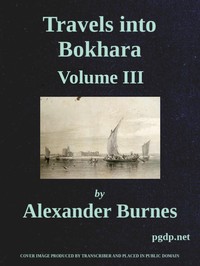
Travels into Bokhara (Volume 3 of 3) Being the Account of A Journey from India to Cabool, Tartary, and Persia; Also, Narrative of a Voyage on the Indus, From the Sea — Story, Setting & Ideas
(0 User reviews)
521
Project Gutenberg
2021
Not confirmed
Asia, Central -- Description and travel; Afghanistan -- Description and travel; Burnes, Alexander, Sir, 1805-1841 -- Travel; Bukhoro (Uzbekistan) -- Description and travel; Indus River Valley -- Description and travel
Readers of public-domain and historical texts
Project Gutenberg digital edition
en
Edition facts
Words
79,517
Reading time
346 min
Text sections
34
This digital edition of Travels into Bokhara (Volume 3 of 3) Being the Account of A Journey from India to Cabool, Tartary, and Persia; Also, Narrative of a Voyage on the Indus, From the Sea — Story, Setting & Ideas is described by source-level measurements including 79,517 words, 5 hr 46 min estimated reading time, and 34 detected text sections.
The text analysis averages about 26.5 words per sentence, while the detected sections provide another way to judge how the source is divided.
Project Gutenberg metadata also associates the work with “Asia, Central -- Description and travel,” connecting these edition facts with the source record’s subject description.
Source:
Project Gutenberg record #66386
In Volume 3 of his Central Asian travels, Alexander Burnes shifts from overland routes to a detailed river voyage down the Indus, blending official mission report with personal observation of Sikh ruler Runjeet Sing's court and military displays.
Editorial Edition Score
4.9/5
★★★★★
★★★★★
Calculated from edition completeness, EPUB availability, text structure and catalogue metadata. Not a user rating.
How this score is calculated
- Description quality20 pts
- Title & short description10 pts
- Source metadata20 pts
- Text length15 pts
- Chapters / structure15 pts
- EPUB file integrity20 pts
Total of 100 points, scaled to a 2.5-5.0 range. Editions with an empty description or a missing EPUB file are not scored.
Edition quality
Read the Text
al of presents from the King of England--Information on the Indus desired--Suggestions for procuring it--Appointed to conduct the Mission to Lahore--Departure from Cutch--Ability of the Navigators--Arrival in the Indus--Phenomena--Scenes of Alexander’s Campaigns--Ebb and flow of the Tides--Correctness of Quintus Curtius--Visited by the Authorities--Forced out of the Country--Correspondence--Return to the Indus--Imminent Danger--Starved out of the Country--Third Voyage to the Indus--Land in Sinde--Negotiations--Advance on Tatta--Sindian Policy and Reasoning--Successful Negotiations 1
Tatta described--Hinglaj, a famous Pilgrimage--Return to the Sea-coast--Notions of the People--Alexander’s Journey--Embarkation on the River--Anecdote--Strictness of Religious Observances--Pulla Fish--Arrival at Hydrabad--Welcome of the Rulers--Presentation at Court--Sindian Meanness--Audience of Leave--Scenery near the Capital 30
Departure from Hydrabad--Sehwun--Crew of the Boats--A Sindian Song--Sehwun described--Reasons for supposing it to be the Territory of the Sindomanni--Pilgrimage--High Antiquity of the Castle of Sehwun--Congratulations from the Ruler of Khyrpoor--Address that Personage--Character of the People--The Indus--Visited by the Vizier of Sinde--Arrival at Khyrpoor--Audience with the Chief--Character of the Sindian Rulers--Arrival at Bukkur--Amusing Predictions--Anecdote of an Afghan--Mihmandar--Alore described--Supposition of its being the Kingdom of Musicanus 51
Quit Bukkur--Curiosity of the People--Reach the Frontiers of Sinde--Farewell Letters--Creditable Behaviour in our Escort--Fish Diet--Costume--Enter Bhawul Khan’s Country--Quit the Indus at Mittun--Effects of this River on the Climate--Enter the Chenab or Acesines--Incident at Ooch--Arrival of Bhawul Khan--Interview with him--Merchants of Bhawulpoor--History of Ooch--Visited by Bhawul Khan--Mountains--Pass the Sutlege--Peculiarity in the Water of two Rivers--Simplicity of the Mihmandar--Enter Runjeet Sing’s Country--Honourable Reception--Exhibition of the Dray-horses--Orders of the Court 81
Voyage in the Country of the Seiks--Shoojuabad--Mooltan; its Antiquity--Probably the Capital of the Malli--Public Buildings--Religious Intolerance--Climate--Phenomena--Date-trees; Traditions of their introduction--Quit Mooltan--Peloo Shrub--Arrangements for our Advance to Lahore--Alexander the Great--Enter the Ravee, or Hydräotes--Tolumba--Visit the Hydaspes--Description of its confluence with the Chenab--Probable identity of a Modern Tribe with the Cathæi--Ruins of Shorkote--Valuable Bactrian Coin found at it--Birds and Reptiles--Heat--Ruins of Harappa--A Tiger Hunt--Seik Courage--Intelligence of the Mihmandar--Letter and Deputation from Lahore--Seik Females 108
Enter Lahore--Presentation to Runjeet Sing--Delivery of the Presents--Copy of a Letter from the King of England--Stud--Hall of Audience--Military Spectacle--Conversations of Runjeet Sing--Amazons--French Officers--City of Lahore--Tomb of Juhangeer--Shalimar of Shah Jehan--Horse Artillery Review--Character of Runjeet Sing--Audience of Leave--Superb Jewels--Dresses of Honour--Runjeet Sing’s Letter to the King--Quit Lahore--Umritsir; its Temples--Reach the Beas, or Hyphasis--Fête of a Seik Chieftain--Reach the Sutlege--Antiquities of the Punjab--Arrival at Lodiana--Exiled Kings of Cabool--Visit them--Journey to the Himalaya Mountains--Interview with the Governor-general--Acknowledgments of his Lordship 148
MEMOIR ON THE INDUS AND ITS TRIBUTARY RIVERS IN THE PUNJAB.
Notice regarding the Map of the Indus 193
A general view of the Indus 199
A comparison of the Indus and Ganges--Propriety of the comparison--Size of the Ganges--Of the Indus--Compared--Slope of the Indus--Conclusions from it--Tides in both Rivers 203
Extent of the Country--Chiefs and Revenue--Power and Conquests--Military Strength--Connection with Persia--External Policy--Internal State--Hydrabad Family--Khyrpoor Family--Meerpoor Family--Condition of the People--Population 212
ON THE MOUTHS OF THE INDUS.
Division of the Indus into two great branches below Tatta--Sata--Buggar--Delta; its extent--Dangers in navigating it--Eleven Mouths of the Indus--The Pittee--Pieteeanee, Jooa, Reechel, Hujamree--Khedywaree, Gora, or Wanyanee--Khaeer, Mull, Seer--Koree, or Eastern Mouth--Advantage of these to Sinde--Coast of Sinde--Tides of the Indus--Curachee Seaport--Boats of the Indus; Dingees and Doondees--Indus adapted for Steam-vessels--Military remarks on the River 228
ON THE DELTA OF THE INDUS.
Inundation of the Delta--Extent--Neglected State--Towns--Population--Jokea Tribe--Fisheries--Animals--Productions--Climate 249
THE INDUS FROM TATTA TO HYDRABAD.
Sand-banks--Course of the River--Towns--Country Supplies--Trade--Means of improving it--Boats; their Deficiency 255
THE INDUS FROM HYDRABAD TO SEHWUN.
Course and Depth--Fulailee River--Current--Importance of this Part of the River--Crossing the Indus--Navigation of it--Towns--Sehwun--Mountains of Lukkee 260
THE INDUS FROM SEHWUN TO BUKKUR.
Position of Bukkur--Fertility of the Country--Current--Eastern Bank of the Indus--Western Bank--Fortress of Bukkur--Roree and Sukkur--Alore; its Antiquity--Khyrpoor and Larkhanu--Productions of the Soil 267
THE INDUS FROM BUKKUR, TILL JOINED BY THE PUNJAB RIVERS.
Breadth and Depth--Boats--Country--Shikarpoor and Subzul--Swell of the Indus--Tribes on the River 275
THE INDUS FROM MITTUN TO ATTOK.
Description of the River--Dera Ghazee Khan--Line of Commerce--Military Expeditions; why they avoided the Indus--Bridging the Indus 281
THE CHENAB, OR ACESINES, JOINED BY THE SUTLEGE, OR HESUDRUS.
Chenab--Junction--Banks of the Chenab--Ooch; its Productions 286
ON BHAWUL KHAN’S COUNTRY.
Limits--Nature of the Country--Its Power and Importance--Daoodpootras; their Descent--The reigning Family--Trade of Bhawulpoor 290
Extent of Runjeet Sing’s Country--Changes in the Seik Government--Probable Consequences of the Ruler’s Death--His Policy--Sirdars--Revenues of the Punjab--Military Resources and Strength--Cities 295
THE CHENAB, OR ACESINES, JOINED BY THE RAVEE, OR HYDRAÖTES.
Chenab Described--Boats on it--Crossing the River--Province of Mooltan 300
THE RAVEE, OR HYDRAÖTES, BELOW LAHORE.
The Ravee--Its tortuous Course and difficult Navigation--Towns--Lahore--Umritsir Toolumba 305
A MEMOIR ON THE EASTERN BRANCH OF THE INDUS, AND THE RUN OF CUTCH.
Volume 3 of Alexander Burnes's Travels into Bokhara departs from the overland journey of the earlier volumes to focus on a river expedition: the descent of the Indus from the sea to Lahore, undertaken in 1831–1833 as part of a British mission bearing gifts to the Sikh ruler Runjeet Sing. The narrative voice here is notably more official and reportorial than in the preceding books, reflecting Burnes's dual role as explorer and political agent. He opens with a formal introduction explaining his prior service in Cutch and the strategic impetus behind the voyage, then moves into a day-by-day account that mixes hydrographic data with observations of local rulers, military reviews, and court ceremonies.
From Official Report to Personal Encounter
The opening pages establish a bureaucratic tone: Burnes recounts his service in the Quartermaster-general's department and the encouragement he received from Lieutenant-General Sir Thomas Bradford. Yet as the narrative progresses, the voice shifts. When describing Runjeet Sing's military review, Burnes adopts a more observational, almost ethnographic style. He notes the horse artillery evolutions—'line and column in every direction'—and remarks on the inferior horses and equipment, but praises the well-cast guns made at Lahore. The pacing here is deliberate, lingering on details of cost and performance before pivoting to the Maharaja's informal breakfast invitation.
This alternation between official report and personal anecdote recurs throughout. Burnes records Runjeet's own words—'Every gun which you now see costs me 5000 rupees annually'—and then describes the meal served in sewn leaves, the ruler handing choice morsels with his fingers. The contrast between the formal review and the intimate, slightly awkward meal creates a layered portrait of the Sikh court.
Pace and Detail in the Court Scenes
Burnes varies his pace markedly when depicting Runjeet Sing. The audience of leave, for instance, is rendered in compressed, almost cinematic strokes: the open gateway, the white cloth instead of a carpet, the small attendance. Then comes the display of the Koh-i-noor diamond, described with precise measurements—'half the size of an egg,' 'weight amounts to 3½ rupees'—and a cautious valuation. The prose slows to dwell on the gem's setting as an armlet with side diamonds 'about the size of a sparrow's egg.'
This measured attention contrasts with the earlier rapid-fire military descriptions. Burnes also includes Runjeet's physical decline—'his chest is contracted, his back is bent'—and his nightly consumption of spirits 'more ardent than the strongest brandy.' Such details, placed alongside the glittering jewels, create a tension between the splendor of the court and the fragility of its ruler. The narrative does not resolve this tension; it simply records both facets.
Voice and the Limits of the Excerpts
Because the excerpts cover only the introductory sections and the Lahore visit, the full range of Burnes's voice remains partially obscured. The voyage narrative proper—the descent of the Indus, the encounters with local chiefs, the hydrographic memoir—is absent from the sample. What is visible is a writer comfortable shifting between the impersonal language of a government report and the vivid, sometimes wry, detail of a personal journal. His description of Runjeet's breakfast politeness—'the thumb and fingers are certainly a poor substitute for the knife and fork'—reveals a dry humor that leavens the official tone.
The pacing in these excerpts is uneven: dense with data in the introduction, then expansive in the court scenes. Readers should expect the full volume to continue this alternation, with stretches of technical river description punctuated by encounters that bring Burnes's observational eye to the fore. The narrative voice is that of a man who is both a servant of empire and a curious traveler, and the tension between those roles shapes every page.
Readers approaching Volume 3 should be prepared for a work that is part travelogue, part diplomatic dispatch. Burnes's attention to material culture—the cost of guns, the weight of diamonds, the construction of carriages—gives the narrative a concrete, almost inventory-like quality. Yet his willingness to record the awkwardness of a shared meal or the physical decay of a powerful ruler adds a human dimension. The river itself, the Indus, is the thread that binds these observations, and Burnes's voice, whether official or personal, never loses sight of the strategic and commercial stakes of his journey.
That rainy afternoon, Burnes’s voyage down the Indus felt less like imperial record than a quiet meditation on leaving—the Sikh court’s gilded tents fading astern, replaced by mudflats and the river’s grey patience. Later, the same melancholic drift surfaced in a stranger’s Spanish journal, where the Alhambra’s fading tiles whispered of similar ghosts. Romantic Spain: A Record of Personal Experiences (Vol. I) — Background and Themes held that same sense of passage, only warmer, like light through a cracked shutter.
There are no reviews for this eBook.
There are no comments for this eBook.
Reader reflection
What did you think of this book?
Answer a few questions and save a private reflection on this device.
Your progress
0
/
10
2
How much did you enjoy the reading experience?
3
Would you pass this book on to a friend?
4
What was the reading difficulty like?
5
Did this book create an emotional response?
6
Did the book offer a fresh perspective?
7
Could you follow the author’s main argument?
8
Did the book give you something worth debating?
9
Which lesson or insight stayed with you?
10