1

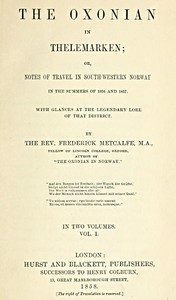
The Oxonian in Thelemarken, volume 1 (of 2) or, Notes of travel in south-western Norway in the summers of 1856 and 1857. With glances at the legendary lore of that district. — Reading Notes
(0 User reviews)
23
Project Gutenberg
2016
Not confirmed
Norway -- Description and travel; Folklore -- Norway
Readers of public-domain and historical texts
Project Gutenberg digital edition
en
Edition facts
Words
68,313
Reading time
298 min
Text sections
8
The catalog record for The Oxonian in Thelemarken, volume 1 (of 2) or, Notes of travel in south-western Norway in the summers of 1856 and 1857. With glances at the legendary lore of that district. — Reading Notes provides practical reading context through 68,313 words, 4 hr 58 min estimated reading time, and 8 detected text sections.
The text analysis averages about 21.1 words per sentence, while the detected sections provide another way to judge how the source is divided.
Project Gutenberg metadata also associates the work with “Norway -- Description and travel,” connecting these edition facts with the source record’s subject description.
Source:
Project Gutenberg record #52195
Frederick Metcalfe's 1858 travelogue blends a clergyman's observations of southwestern Norway with local folklore, including bear stories and legendary lore, as he navigates the region's landscapes and culture.
Editorial Edition Score
4.7/5
★★★★★
★★★★★
Calculated from edition completeness, EPUB availability, text structure and catalogue metadata. Not a user rating.
How this score is calculated
- Description quality20 pts
- Title & short description10 pts
- Source metadata20 pts
- Text length15 pts
- Chapters / structure15 pts
- EPUB file integrity20 pts
Total of 100 points, scaled to a 2.5-5.0 range. Editions with an empty description or a missing EPUB file are not scored.
Edition quality
Read the Text
ssion--The stirring of the blood--A bachelor’s wild scream of liberty--What marriage brings a salmon-fisher to--Away, for the land of the mountain and the flood--“Little” circle sailing--The Arctic shark--Advantages of gold lace--A lesson for laughers--Norwegian coast scenery--Nature’s grey friars--In the steps of the Vikings--The Norwegian character--How the Elves left Jutland--Christiansand harbour pp. 1-15
Disappointed fishermen--A formidable diver--Arendal, the Norwegian Venice--A vocabulary at fault--Ship-building--The Norwegian Seaboard--Sandefjord, the Norwegian Brighton--A complicated costume--Flora’s own bonnet--Bruin at large--Skien and its saw-mills--Norway cutting its sticks--Wooden walls--Christopher Hansen Blum--The Norwegian phase of religious dissent--A confession of faith--The Norsk Church the offspring of that of Great Britain pp. 16-28
A poet in full uniform--The young lady in gauntlet gloves again--Church in a cave--Muscular Christianity in the sixteenth century--A miracle of light and melody--A romance of bigotry--How Lutheranism came in like a lion--The Last of the Barons--Author makes him bite the dust--Brief burial-service in use in South-western Norway--The Sörenskriver--Norwegian substitute for Doctors’ Commons--Grave ale--A priestly Samson--Olaf’s ship--A silent woman--Norwegian dialects--Artificial salmon-breeding--A piscatorial prevision pp. 29-47
Mine host at Dal--Bernadotte’s prudent benignity--Taxing the bill of costs--Hurrah for the mountains--Whetstones--Antique wooden church--A wild country--“Raven depth”--How the English like to do fine scenery--Ancient wood-carving--A Norwegian peasant’s witticism--A rural rectory--Share and chair alike--Ivory knife-handles--Historical pictures--An old Runic Calendar--The heathen leaven still exists in Norway--Washing-day--Old names of the Norsk months--Peasant songs--Rustic reserve--A Norsk ballad pp. 48-68
A lone farm-house--A scandal against the God Thor--The headquarters of Scandinavian fairy-lore--The legend of Dyrë Vo--A deep pool--A hint for alternate ploughboys--Wild goose geometry--A memorial of the good old times--Dutch falconers--Rough game afoot--Author hits two birds with one stone--Crosses the lake Totak--A Slough of Despond--An honest guide--A Norwegian militiaman--Rough lodgings--A night with the swallows--A trick of authorship--Yea or Nay pp. 69-81
No cream--The valley of the Maan--The Riukan foss--German students--A bridge of dread--The course of true love never did run smooth--Fine misty weather for trout--Salted provisions--Midsummer-night revels--The Tindsö--The priest’s hole--Treacherous ice--A case for Professor Holloway--The realms of cloud-land--Superannuated--An ornithological guess--Field-fares out of reach of “Tom Brown”--The best kind of physic--Undemonstrative affection--Everywhere the same--Clever little horses pp. 82-96
An oasis--Unkempt waiters--Improving an opportunity--The church in the wilderness--Household words--A sudden squall--The pools of the Quenna--Airy lodgings--Weather-bound--A Norwegian grandpapa--Unwashed agriculturists--An uncanny companion--A fiery ordeal--The idiot’s idiosyncrasy--The punctilious parson--A pleasant query--The mystery of making flad-brod--National cakes--The exclusively English phase of existence--Author makes a vain attempt to be “hyggelig”--Rather queer pp. 97-113
Northwards--Social colts--The horse shepherd--The tired traveller’s sweet restorer, tea--Troll-work--Snow Macadam--Otter hunting in Norway--Normaends Laagen--A vision of reindeer--The fisherman’s hut--My lodging is on the cold ground--Making a night of it--National songs--Shaking down--A slight touch of nightmare pp. 114-128
The way to cure a cold--Author shoots some dotterel--Pit-fall for reindeer--How mountains look in mountain air--A natural terrace--The meeting of the waters--A phantom of delight--Proves to be a clever dairymaid--A singular cavalcade--Terrific descent into Tjelmö-dal--A volley of questions--Crossing a cataract--A tale of a tub--Author reaches Garatun--Futile attempt to drive a bargain pp. 129-141
The young Prince of Orange--A crazy bridge--At the foot of the mighty Vöring Foss--A horse coming downstairs--Mountain greetings--The smoke-barometer--The Vöring waterfall--National characteristics--Paddy’s estimate of the Giant’s Causeway--Meteoric water--New illustrations of old slanders--How the Prince of Orange did homage to the glories of nature--Author crosses the lake Eidsfjord--Falls in with an English yacht and Oxonians--An innkeeper’s story about the Prince of Orange--Salmonia--General aspect of a Norwegian Fjord--Author arrives at Utne--Finds himself in pleasant quarters--No charge for wax-lights--Christian names in Thelemarken--Female attire--A query for Sir Bulwer Lytton--Physiognomy of the Thelemarken peasants--Roving Englishmen--Christiania newspapers--The Crown Prince--Historical associations of Utne--The obsequies of Sea Kings--Norwegian gipsies pp. 142-160
From Fairy-lore to Nature-lore--Charming idea for stout folk--Action and reaction--Election-day at Bergen--A laxstie--A careless pilot--Discourse about opera-glasses--Paulsen Vellavik and the bears--The natural character of bears--Poor Bruin in a dilemma--An intelligent Polar bear--Family plate--What is fame?--A simple Simon--Limestone fantasia--The paradise of botanists--Strength and beauty knit together--Mountain hay-making--A garden in the wilderness--Footprints of a celebrated botanist--Crevasses--Dutiful snow streams--Swerre’s sok--The Rachels of Eternity--A Cockney’s dream of desolation--Curds-and-whey--The setting-in of misfortunes--Author’s powder-flask has a cold bath--The shadows of the mountains--The blind leading the blind--On into the night--The old familiar music--Holloa--Welcome intelligence pp. 161-187
Frederick Metcalfe, an Oxford fellow, opens his 1858 travelogue with a preface that uses a Norman superstition about a shape-shifting horse-sprite as a metaphor for the perils of authorship. He warns that writers who mount the 'Pegasus of imagination' risk a fall, a fate he acknowledges even as he proceeds. This self-deprecating frame sets the tone for a work that is as much about the traveler's perspective as the places visited.
The narrative proper begins with a journey into Thelemarken, where Metcalfe's attention quickly shifts from scenery to the people he encounters. A local recounts a harrowing bear attack, told with vivid detail—the victim stuffing himself into a cliff crevice while bears bite his legs. Metcalfe listens, then asks for another story, signaling his appetite for the region's oral traditions. This early exchange establishes the book's dual focus: travel notes and legendary lore.
A Clergyman's Curiosity
Metcalfe does not pose as a hardened explorer. He is a clergyman and Oxford fellow, and his observations are filtered through a scholarly yet amiable lens. When a boatman marvels at his 'skue-spil kikkert' (theatre-glass), Metcalfe notes the man's familiarity with Bergen's entertainments—a juggler and rope-dancer preferred to a play. This exchange reveals the author's interest in local attitudes, not just landmarks. He records dialect terms like bidsel (iron bit) and sæter (mountain pasture), embedding linguistic notes into the travelogue. His voice is that of a curious outsider who respects his informants, letting them speak at length. The bear stories, for instance, are told in the boatman's own words, with Metcalfe interjecting only to prompt another tale. This method gives the narrative a documentary quality, capturing the rhythms of oral storytelling.
Bears, Bits, and Legendary Echoes
The bear encounters in the excerpts are not mere anecdotes; they connect to older traditions. Metcalfe links a modern weapon—a horse's bit used to fend off a she-bear—to a medieval saga: Snorri Sturluson's account of Arek and Erek, whose heads were 'punched in' with their horses' bits. This juxtaposition of contemporary and ancient is a recurring technique. The white bear that swims ashore from Spitzbergen, shot while raising its paws in supplication, carries a folkloric weight, though Metcalfe offers a rational explanation (escape from a ship). He does not force interpretations but lets the stories resonate. The preface's Norman sprite, the bear legends, and the saga reference together create a web of allusions that reward readers attentive to patterns. Metcalfe's 'glances at legendary lore' are precisely that—brief, suggestive looks rather than exhaustive studies.
The Landscape as Stage
Setting in this travelogue is functional, not merely scenic. The narrow scaur where Paulsen meets the bears, the cliff over the fjord where a bear breaks its neck, the sæter where girls fear a bear's approach—these are stages for human-animal encounters. Metcalfe describes topography only as needed: a 'deep scaur in the side of the mountain,' a 'place where there was no getting away.' His double glass (telescope) is used to spot Vellavik, but the focus stays on the story attached to that speck. The landscape is inhabited, storied, and often dangerous. Readers should note how Metcalfe moves between dialogue and description: a boatman's pointing gesture ('Such a place as that yonder') anchors the tale in visible geography. This technique gives the narrative a grounded, immediate feel, as if the reader is traveling alongside the author, hearing the same voices.
Reading Between the Lines
Because the excerpts cover only the opening and a middle section, the full arc of the two volumes remains unknown. Metcalfe's preface suggests he expects criticism, but whether the book was well-received is not indicated. The catalog subjects—Norway description and travel, folklore—confirm the dual focus, but the proportion of each is unclear. Readers should approach the text as a hybrid: part personal narrative, part ethnographic record. The author's academic background (Fellow of Lincoln College, Oxford) may color his observations, but the excerpts show him deferring to local knowledge. The bear stories, for instance, are told by a boatman, not a scholar. This editorial note cannot verify the accuracy of the legends or the travel details; it can only point to the texture of the writing. A first-time reader might watch for how Metcalfe balances his own voice with those of his informants, and how the legendary lore shades into the travel notes.
This travelogue rewards readers who enjoy digression and anecdote over straight itinerary. Metcalfe's willingness to let a boatman dominate several pages with bear stories signals that his interest lies in people as much as places. The preface's warning about authors who 'get a fall' may be playful, but it also hints at a self-awareness rare in Victorian travel writing. Approach the book as a conversation with a well-read companion who is happy to pause for a legend, a dialect word, or a saga parallel. The journey through Thelemarken is as much through its stories as its valleys.
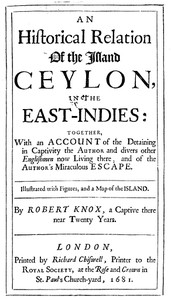
That grey afternoon, rain drumming on the window, I was lost in Metcalfe’s Norway—the way he’d pause on a muddy track to recount a bear tale, as casually as noting church spires. His patience for the odd aside, for a story tucked inside a landscape, made me wonder about other captive travellers. I soon found myself leafing through An Historical Relation of the Island Ceylon in the East Indies Together with an Account of the Detaining in Captivity the Author and Divers other Englishmen Now — Background and Themes, sharing that same unhurried, curious drift.
There are no reviews for this eBook.
There are no comments for this eBook.
Reader reflection
What did you think of this book?
Answer a few questions and save a private reflection on this device.
Your progress
0
/
10
2
How did the book work for you overall?
3
Would you recommend this book to another reader?
4
Did the language feel accessible?
5
What was its emotional impact?
6
Did any part of the book feel personally relevant?
7
Could you follow the author’s main argument?
8
Did the book offer a fresh perspective?
9
What changed or sharpened your thinking?
10