1

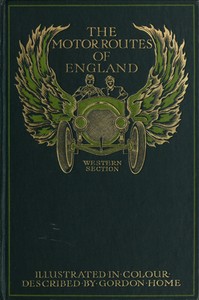
The Motor Routes of England: Western Section — Reading Companion
(0 User reviews)
253
Project Gutenberg
2013
Not confirmed
England -- Description and travel
Readers of public-domain and historical texts
Project Gutenberg digital edition
en
Edition facts
Words
62,050
Reading time
270 min
Text sections
10
Before opening The Motor Routes of England: Western Section — Reading Companion, the edition data offers a quick orientation: 62,050 words, 4 hr 30 min estimated reading time, and 10 detected text sections.
The text analysis averages about 18.9 words per sentence, while the detected sections provide another way to judge how the source is divided.
Project Gutenberg metadata also associates the work with “England -- Description and travel,” connecting these edition facts with the source record’s subject description.
Source:
Project Gutenberg record #43246
A motorist's route guide to western England and Wales, blending practical road notes with historical and architectural observations, structured as sequential drives with recurring attention to river valleys, castle sites, and local character.
Editorial Edition Score
4.8/5
★★★★★
★★★★★
Calculated from edition completeness, EPUB availability, text structure and catalogue metadata. Not a user rating.
How this score is calculated
- Description quality20 pts
- Title & short description10 pts
- Source metadata20 pts
- Text length15 pts
- Chapters / structure15 pts
- EPUB file integrity20 pts
Total of 100 points, scaled to a 2.5-5.0 range. Editions with an empty description or a missing EPUB file are not scored.
Edition quality
Read the Text
er being captured by the other side was plundered, like most of the mansions in this county. About a mile farther on ~Aldersey Hall~ stands to the left, about ten furlongs from the road. It is asserted that it has been occupied by the family of that name since the Norman Conquest.
In ~Handley Church~ a good brass may be seen of the Venables family, and ~Calveley Hall~, once a manor-house and now converted into a farmhouse, has a good oak staircase and some excellent wainscotting in the rooms.
~Rowton Moor~ is reached next, where the Royalists suffered a defeat in 1645. The road passes through the battlefield.
[Map: TOWN PLAN NO. 4--CHESTER.]
From Shrewsbury the road into Chester leads into Foregate Street, and presently, after passing through a street of uninteresting suburban character, the city proper is entered by the east gate in the walls, the archway of which passes over the road. Upon the left is the Grosvenor, a comfortable and well-managed hotel, conveniently situated as a centre for seeing the many features of interest in Chester. The journey from London along the Watling Street has been upon the track of the Roman legions, and here at Chester--the ancient Deva--is found the ultimate object of their journey, for this was the headquarters of the famous Twentieth Legion, which occupied the town shortly before the Boadicean Rebellion in A.D. 61, and remained there until the evacuation of Britain in the early part of the fifth century. The old town is suggestive of Rome's imperial power, for the ichnography of the city to-day resembles in a remarkable fashion the great military castra of the conquerors of the world.
[Map: PLAN OF CHESTER CATHEDRAL. _Based on that published by the late Dean Howson._]
One of the first objects of interest is the ~Cathedral~, situated about two minutes from the hotel by passing up Werburgh Street. It is one of the red cathedrals, and owing to the sandstone of which it is composed being of a friable nature, the veneering of the edifice with new stone unfortunately deprives it of that aspect of age so characteristic of the majority of the great churches of England. The earliest building standing on the site is said to have been put up in the second century, but of that no traces exist. The present structure dates from the twelfth century, and has architecture as recent as the sixteenth. Upon entering by the west door some Norman work is apparent at the end of the nave, but its general style is Perpendicular; there is no triforium, and the fenestration springs directly above the arches, where an unornamental balustrading breaks the junction. The huge Perpendicular window at the west end is not of any particular merit. The large south transept was until recently used as a parish church, and is remarkably spacious; it is late Decorated, and possesses beautiful tracery in the window of the west aisle. Passing into the choir, which is early Decorated, and has been completely restored, one finds some exquisite work in the canopies of the stalls, which are undoubtedly the finest in the kingdom. Especially interesting are the quaint misereres; the Bishop's throne and pulpit are, however, modern. A characteristic feature of architecture occurs in the triforium, where four arches are superposed upon each of the bays below them. In the north aisle wall are preserved some magnificent mosaics, presented to the cathedral in 1886. The screen across the choir is Perpendicular, and of singular beauty, but it prevents the eye from perceiving the full length of the church, making it appear shorter than is actually the case. The north transept is small, with Norman work below and Perpendicular above. It will readily be seen that there are two periods in the Norman work. The large tomb on the floor of this transept is the resting-place of Bishop Pearson, who died in 1696. He is well known for his work on the Creed. The cloisters are entered through a Norman doorway at the east end of the north wall of the nave; the style throughout is Perpendicular, and the work on three sides of the square is picturesque; the south side, which had perished, has been rebuilt. An early Norman passage lies along the west side of the cloister. The chapter-house, which may be entered from this spot, is exceptionally worthy of a visit. It is of Early English architecture and a beautiful example of the style; the vestibule is, perhaps, more chaste than the chapter-house, and the manner in which the mouldings of the pillars run up unbroken into the vaulting is a striking feature.
Gordon Home's Motor Routes of England: Western Section is organized as a series of numbered trunk routes, each beginning at a named town and proceeding to another. The volume, published in 1911, treats the road itself as the primary subject, with the landscape and its historical features arranged along the line of travel. The preface notes that Home and his collaborator Charles H. Ashdown motored over most of the routes together, and Ashdown drove a portion alone to ensure fresh observation. The book's structure thus mirrors the sequence of a journey, with each route forming a discrete chapter that moves from point to point, noting gradients, turnings, and places of interest in the order a motorist would encounter them.
Route as Narrative Spine
The book's organizing principle is the route itself. Each chapter is a trunk road, and the text follows the road's course, describing what appears beside it. For example, Route 8 runs from Llangurig to Abergavenny, and the narrative moves through Rhayader, Builth Wells, Talgarth, and Crickhowell in sequence. The road is the thread that connects these places, and the descriptions are keyed to the motorist's view: 'The road to Rhayader traverses part of the Upper Wye Valley, and gives frequent glimpses of troubled, foam-flecked water.' The structure imposes a linear, forward-moving perspective, and the reader is always aware of the next town or landmark ahead.
Recurring Images: Water and Stone
Two images recur across the excerpts: water in motion and the remains of stone structures. The Wye is described as 'an impetuous mountain stream, plunging amid the rocks,' and later as losing 'its torrential character' to become 'calm and placid.' The Birmingham Corporation Reservoirs appear as a modern intervention, a 'gigantic undertaking' that will create 'a chain of lakes.' Castle sites are noted repeatedly: Builth Castle has 'a double fosse, a rampart of earth, and a keep' of 'great size'; Bronllys Castle is mentioned at Talgarth; and Abergavenny Castle is now 'a recreation-ground.' The juxtaposition of natural watercourses and human-built stone—whether medieval fortifications or modern reservoirs—gives the landscape a layered quality.
Movement Between Scenes: The Motorist's Pace
The text shifts between broad landscape views and close-up details, mimicking the changing pace of a car journey. A passage may begin with a sweeping description of 'pastoral scenery, bounded by the rounded uplands,' then narrow to a specific warning: 'Between Rhayader and Builth there are several very sharp turnings in the road, requiring considerable care.' The motorist's speed and attention are implied throughout. At Builth, the narrative pauses for a historical anecdote about Llewelyn's death in 1282, then resumes with the road to Talgarth, passing Erwood and Garth Hill. This alternation between scenic overview and pointed detail—whether a sharp bend or a site of historical interest—creates a rhythm that suits the touring motorist's experience.
Local Character Through Anecdote and Observation
The book conveys local character through brief, often wry observations. Of Builth Wells, it notes that 'a regiment might be raised locally all bearing the surname of Price or Powell.' Rhayader is described as 'a small and uninteresting town' but a 'paradise' for anglers and a 'good sketching-ground for artists.' The text does not shy from blunt judgments: Builth's church is 'a modern erection, and the town is uninteresting.' These remarks, placed alongside historical notes (the Roman name Bullaeum, the siege of 1260), give each place a distinct identity. The effect is that of a knowledgeable companion who points out what is worth seeing and what may be passed by, always with the road ahead in mind.
This guide rewards a reader who follows its routes in order, as the sequence of towns and landscapes builds a cumulative picture of western England and Wales. The motorist's perspective—moving through, not lingering—shapes what is noticed: the condition of the road, the character of a river, the outline of a castle on a hill. Home and Ashdown have produced a work that is both practical and evocative, a record of Edwardian touring that remains legible a century later.
Years at the desk, I’ve noticed the oddest pairings settle side by side. The Motor Routes of England hums with rivers and ruined keeps, a slow reverence for place. That same patient eye for stones and story lingers in the Italian hills of Sketches and Studies in Italy and Greece, First Series — Themes and Context. Both were written by travelers who stopped, looked, and remembered quietly.
There are no reviews for this eBook.
There are no comments for this eBook.
Reader reflection
What did you think of this book?
Answer a few questions and save a private reflection on this device.
Your progress
0
/
10
2
What was your overall reaction to the book?
3
How likely are you to recommend this book?
4
How demanding did the text feel?
5
How did the pace of the book feel?
6
How personally connected did you feel to the book?
7
How valuable was this book for your own interests?
8
Did the book meet your expectations?
9
What is the main idea you are taking away?
10