1

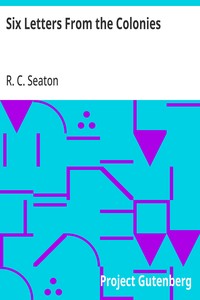
Six Letters From the Colonies — Background and Themes
(0 User reviews)
24
Project Gutenberg
2009
Not confirmed
Australia -- Description and travel
Readers of public-domain and historical texts
Project Gutenberg digital edition
en
Edition facts
Words
26,524
Reading time
116 min
Text sections
3
This digital edition of Six Letters From the Colonies — Background and Themes is described by source-level measurements including 26,524 words, 1 hr 56 min estimated reading time, and 3 detected text sections.
The text analysis averages about 20.1 words per sentence, while the detected sections provide another way to judge how the source is divided.
Project Gutenberg metadata also associates the work with “Australia -- Description and travel,” connecting these edition facts with the source record’s subject description.
Source:
Project Gutenberg record #29609
Seaton's 1885 letters contrast sailing-ship romance with steamer practicality, then tour Victoria, South Australia, and Tasmania. His impressions of Adelaide's dammed Torrens and a South Australian ostrich farm reveal a dry, observant style that blends travelogue with colonial curiosities.
Editorial Edition Score
4.6/5
★★★★★
★★★★★
Calculated from edition completeness, EPUB availability, text structure and catalogue metadata. Not a user rating.
How this score is calculated
- Description quality20 pts
- Title & short description10 pts
- Source metadata20 pts
- Text length15 pts
- Chapters / structure15 pts
- EPUB file integrity20 pts
Total of 100 points, scaled to a 2.5-5.0 range. Editions with an empty description or a missing EPUB file are not scored.
Edition quality
Read the Text
Greenwich was crossed in lat. 38 degs. south. "The meridian of the Cape of Good Hope," says the captain's log, "was crossed on the 65th day out, in lat. 35-1/2 degs. south, and the longitude was run down in the parallel of 42 degs. south. Light winds stuck to the barque persistently, and as an illustration of the tedious weather, it may be mentioned that not a topgallant sail was taken in from Biscay to St. Paul's, and the average running in crossing the Southern Ocean was only 161 miles per day." The last land sighted was the Island of Trinidad--an uninhabited rock--in lat. 20°45' south, long. 29°48' west. This was on the 16th January and for seven "solid" weeks from then we were out of sight of land. This time was redeemed from monotony by tournaments of chess and whist, which filled up the evenings. There were frequent small quarrels, with reconciliations more or less sincere, which also afforded distraction. After one the captain let off a rocket, also one of Holmes's patent "flare-ups." This is a contrivance for saving life during the dark. It consists of a box filled with potassium, which is pierced at both ends and thrown into the sea fastened to a life-buoy. In contact with the water the metal ignites, and for about half-an-hour sheds a radiance for a long way. It is visible for miles off. If a man falls overboard he knows then where to look out for the life-buoy.
The Canon was an adept at shorthand, and a class was formed on board of 12 of the saloon passengers, who prosecuted it most vigorously, and really made much progress. An examination was held at the end of the course of lessons, and prizes awarded. Several entertainments--musical and dramatic--were given, nearly all of which proved successful, the very causes of failure on land being often at sea the cause of success. The prompter was, I remember, on one occasion much more audible than the actor. Another time the stage (the main deck) was flooded with sea water, which increased rather than diminished with every roll. A chorus of youths and maidens endeavouring to sing and keep their balance is amusing if not æsthetic. Everything, in fact, suffers a "sea change," if not into something "rich and strange," often into something expensive. The first time a passenger ventures on the forecastle or up the rigging--the peculiar realms of the sailor--Jack chalks him, which means that he must pay his footing, by sending a bottle of whisky for'ard. It is seldom that a stranger long escapes "spotting" under these circumstances. As a curiosity I may mention that one passenger paid 8s. for a few things being washed; this was at the moderate price of 6d. each article, no matter whether it was a collar or a shirt. I should strongly advise anyone going a long voyage to take a spirit lamp, as it is often difficult to get hot water unless the thirst of the cook is constantly allayed. Deck shoes are very convenient, more especially in the tropics, where one leads a lotus-eating existence. This is the most delightful part of the voyage in my opinion, though some prefer the more bracing air of the Southern Ocean. Without being malicious, however, it is difficult not to fancy that the pleasure of finding midsummer weather in January is heightened by the contrast with London fogs and frost, which we know those at home are suffering from. The greatest resource of all is reading, and some of us get through a good deal of it, but it is too tempting, and often interferes with taking regular exercise, which, though irksome, is almost essential to good health at sea.
Seaton opens his first letter by defending the sailing ship against the steamer, calling the voyage in a windjammer 'quite exhilarating' and lamenting that 'romance is perishing from the sea.' He contrasts the sailor's chanties and the ship's 'leaps and bounds' with the steamer's 'labouring plunges' and better food. This personal, opinionated voice sets the tone for a series that is less a systematic survey than a collection of vivid, sometimes wry, impressions.
The preface admits the letters were revised after his return, and that he offers 'impressions as such, not as matured opinions.' Readers should expect a subjective, episodic account rather than a comprehensive guide.
A Sailor's-Eye View of the Voyage
Seaton devotes his first letter entirely to the passage from England to Australia aboard the Hampshire. He is keenly attentive to the sensory details of life under sail: the crew's work songs, the daily variability of distance covered, and the exhilaration of twelve-knot speeds. His nostalgia for the 'picturesqueness' of sail is tempered by a grudging admission that steamers offer better food—a prosaic advantage that, he notes, 'with many people would decide in favour of a steamer.'
The letter is structured as a series of contrasts: the romance of the sailing ship versus the efficiency of the steamer, the sailor's skill versus the machine's power. Seaton's voice is that of an educated traveller who enjoys a good-humoured digression, as when he imagines Byron's pirate aboard a steamer. Readers should note that this opening establishes a pattern of personal, anecdotal observation that continues throughout the later letters.
Melbourne and Victoria: First Impressions
The second and third letters cover Melbourne and the colony of Victoria. Seaton describes the city's layout, public buildings, and suburban life, but his interest is less in statistics than in characteristic scenes. He notes the 'sullen mole' of the River Torrens in Adelaide, which the municipality dammed into a lake, turning 'an eyesore into an ornament.' This attention to human intervention in the landscape recurs when he visits an ostrich farm near Gawler.
At the farm, Seaton's dry humour emerges: the manager, a 'dry old Scotchman,' recounts being kicked by an ostrich and handing its neck over a fence to escape. Seaton observes that ostriches 'will run up against palings or wire, get their long necks entangled, and sometimes cut their throats.' Such details—quirky, specific, and slightly macabre—are typical of his method. He does not generalise about colonial agriculture but instead offers a close-up of one enterprise.
South Australia: Rivers, Gardens, and Ostriches
The fourth letter turns to South Australia. Seaton is struck by the Torrens's intermittent flow—'like many Australian rivers, the Torrens starts up in various places and does not seem to have either a beginning or an ending.' He praises Adelaide's botanical and zoological gardens, noting a black cockatoo and a white peacock as curiosities. The visit to the ostrich farm occupies much of the letter, and Seaton recounts the manager's methods with evident relish.
He describes the birds' aggressive behaviour: 'An ostrich, in attacking, kicks forward with his legs, which give tremendous blows, and then, when he has kicked down his enemy, he will probably sit upon him.' The manager's tactic of sitting down when ostriches run away—'you can't catch them'—is offered without comment, leaving the reader to smile at the practical wisdom. Seaton also notes the economic context: a £100 export embargo from the Cape, which he calls 'locking the stable door when the horse has escaped.'
Tasmania, Auckland, and Sydney: A Closing Tour
The final two letters cover Tasmania, Auckland, and Sydney. Seaton's descriptions become more compressed, as if time or energy is running short. He notes Tasmania's scenery and the growing city of Auckland, but the excerpts available do not reveal extended set-pieces. What emerges is a traveller who is consistently more interested in the odd or the characteristic than in the monumental.
Throughout, Seaton maintains the epistolary fiction: he addresses the reader directly, uses the first person, and occasionally refers to events after his return. The letters were originally published in the Eastern Morning News, and their tone is that of a newspaper correspondent—informative but personal, with a journalist's eye for the telling detail. Readers should approach the later letters as a coda to the more leisurely earlier ones, noting how the author's energy flags or shifts focus.
Seaton's letters reward a reader who enjoys the incidental over the systematic. His voice—opinionated, dry, and alert to the absurd—gives unity to a journey that might otherwise seem a mere catalogue of colonies. The ostrich farm, the dammed river, the sailing-ship romance: these are the moments that linger. To read Six Letters From the Colonies is to travel with a companion who is never quite sure what he thinks, but knows what he sees.
Reading about Seaton’s dry-eyed account of Adelaide’s parched Torrens, I remembered how my own travel journals drift toward the practical, the odd detail—an ostrich farm, a dammed river—rather than the romance I’d expected. That same quiet, observational patience filled me when I first held History of Cuba; or, Notes of a Traveller in the Tropics Being a Political, Historical, and Statistical Account of the Island, from its First Discovery to the Present — Inside the Classic. Both books felt like letters from someone who simply watched, unhurried, letting strange places become familiar through patience.
There are no reviews for this eBook.
There are no comments for this eBook.
Reader reflection
How did this book work for you?
Your answers remain private and are stored only in this browser.
Your progress
0
/
10
2
Did this book hold your interest?
3
Is this a title you would suggest to others?
4
How much effort did this book require?
5
Did this book create an emotional response?
6
How distinctive were its ideas or approach?
7
Would you like to discuss this book with someone?
8
What did you think about the pace?
9
What did this book teach you most?
10