1

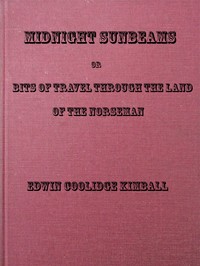
Midnight Sunbeams; or, Bits of Travel Through the Land of the Norseman — A Reader’s Guide
(0 User reviews)
819
Project Gutenberg
2018
Not confirmed
Scandinavia -- Description and travel
Readers of public-domain and historical texts
Project Gutenberg digital edition
en
Edition facts
Words
57,623
Reading time
251 min
Text sections
20
The catalog record for Midnight Sunbeams; or, Bits of Travel Through the Land of the Norseman — A Reader’s Guide provides practical reading context through 57,623 words, 4 hr 11 min estimated reading time, and 20 detected text sections.
The text analysis averages about 28.6 words per sentence, while the detected sections provide another way to judge how the source is divided.
Project Gutenberg metadata also associates the work with “Scandinavia -- Description and travel,” connecting these edition facts with the source record’s subject description.
Source:
Project Gutenberg record #56781
Kimball's travelogue moves through Norway, Sweden, and Denmark via steamer, rail, and foot, contrasting unspoiled interiors with tourist-impacted coasts. The narrative is structured around scenic set-pieces—fjords, glaciers, mountain passes—and punctuated by recurring images of light, water, and rock.
Editorial Edition Score
4.8/5
★★★★★
★★★★★
Calculated from edition completeness, EPUB availability, text structure and catalogue metadata. Not a user rating.
How this score is calculated
- Description quality20 pts
- Title & short description10 pts
- Source metadata20 pts
- Text length15 pts
- Chapters / structure15 pts
- EPUB file integrity20 pts
Total of 100 points, scaled to a 2.5-5.0 range. Editions with an empty description or a missing EPUB file are not scored.
Edition quality
Read the Text
rently, had entered the manager’s mind that one could easily have walked off, without first conferring with the woman at the coffee urn.
After dinner there was time for a short walk up and down the platform, and then we continued our journey through a country where the rail fences, red farm houses, pine trees, and abundance of stumps and rocks, made us imagine we were in Maine or New Hampshire, instead of on the other side of the “great pond.” The scenery improved, and in places was beautiful, especially as we skirted the shores of a chain of lakes formed by the Ljusne river; and under a sky burning with the gorgeous coloring of a brilliant Northern sunset, we arrived at half-past nine at the little station where we were to take supper. Here was the same arrangement as at dinner, each one waiting upon himself, and a good supper of fish, hot and cold meats, eggs, tea and coffee was furnished for thirty cents, which is likewise the charge for a substantial breakfast.
There were few passengers on the train, and during most of the day we two had had a compartment to ourselves. There are no sleeping cars on the route, so as it was getting late we closed and fastened the doors of our compartment, drew the curtains to shut out the bright light of the Northern night, and lying on the long seats covered with our thick railway rugs slept undisturbed, until suddenly awakened by a loud rapping at our door. The train was in a station, female voices were calling to us in Swedish, and we sprang up anxious to learn the cause of this unlooked-for visitation. But when the door was opened, the dear creatures beat a hasty retreat the moment they saw us, and evidently were as surprised as ourselves at our meeting; as we soon heard their voices in a neighboring compartment, we knew they had found those they were seeking.
At five o’clock in the morning we arrived at Ostersund, where the train stopped for an hour. We paid four cents and entered a toilet room with marble wash-bowls, brushes, an abundance of fresh towels, and that article which is never furnished free in Europe—soap. After taking bread and coffee, and a brisk walk, we felt as fresh and rested as though we had passed the night in the state-room of a vestibule Pullman.
We had previously congratulated each other on having a compartment to ourselves; on resuming our journey, during the entire forenoon, we were the sole occupants of a whole car.
We skirt the shores of a series of lakes connected by rivers, and then through a dreary country ascend the range of mountains separating Sweden from Norway. We pass through snow sheds, and between high board fences built to keep the drifting snow from the track (both much simpler in construction than those along the roads crossing the Rocky Mountains), and in the midst of snow banks, enveloped in a thick chilling mist, arrive at Storlien, two thousand feet above sea-level, the last station in Sweden. We gather for the last time about the _smörgasbord_ (we never saw it later in Norway), and a good dinner cheers us in our desolate surroundings.
Then we enter the Norwegian train of second and third class carriages, on the common European model of compartments entered from the sides, with the second class, in their fittings, fully equal to the first of many other countries, and begin the descent to the sea coast. The snow mountains are veiled by clouds, there is little vegetation, barren rocks are succeeded by marshy land and swamps, but soon we emerge from the mist into bright sunshine.
We are the only occupants of the second class carriage; the guard, who speaks English, opens the door as we arrive at a station and tells us how long we are to stop, and following the general custom we get out for a few minutes’ walk, and to look at the natives.
We were both intently reading when the door opened and the guard made this startling announcement: “Gentlemen, this is Hell; we stop five minutes.” We hastily left our seats to see the place against which we had been warned all our lives, hoping at least to refresh ourselves with a few glasses of sulphur water. No fumes of sulphur, no odor of brimstone greeted us, but instead, “a nipping and an eager air” enveloped the forlorn little settlement, even on that summer afternoon. Whatever _Hell_ may signify in Norwegian, this place is decidedly different as regards climate from that of the same name mentioned in King James’ version.
Edwin Coolidge Kimball’s Midnight Sunbeams is structured as a sequence of discrete travel episodes, each anchored to a specific location or mode of transport. The book moves from Copenhagen through Sweden’s Gotha Canal, then to Stockholm, and onward into Norway’s fjord country and Arctic reaches. Kimball frequently pauses to compare landscapes—the Romsdal valley to Yosemite, for instance—and to note the effects of tourism on local hospitality. The narrative’s rhythm alternates between leisurely steamer passages and strenuous mountain walks, with recurring attention to light conditions, especially the prolonged daylight of northern latitudes.
Movement by Water and Rail
The journey’s structure depends heavily on scheduled transport: steamers along the Gotha Canal, coastal vessels in the Nordland, and railways across Sweden. Kimball describes the Venus as a floating microcosm where passengers keep meal accounts, and he notes the efficiency of Swedish railway meal stations. Water travel dominates the Norwegian chapters, with the steamer threading through island belts and fjords. The author’s attention to timetables and connections gives the narrative a practical, logistical texture, while the constant motion underscores the transience of the traveler’s perspective.
Recurring Images: Light, Rock, and Water
Three elements recur throughout the excerpts: the quality of northern light, the verticality of rock formations, and the sound of moving water. Kimball describes the Romsdalshorn’s granite sides as “straight and smooth as if it were an immense cheese,” and the Trolltinder as “weird and fantastic forms.” The river Rauma “leaps and foams” in narrow valleys, while the Svartisen glacier appears as a crystal mass. These images are not merely decorative; they structure the reader’s sense of scale and atmosphere, contrasting the stillness of rock with the constant motion of water and light.
The Contrast Between Unspoiled and Touristed Norway
Kimball draws a sharp distinction between the interior, where natives still offer “homelike cheer,” and the coastal routes where tourists have made locals “calculating” and prone to overcharge. He criticizes large parties of “Cookies and the ‘personally conducted’” for spoiling the straightforwardness of the people. This observation recurs as a structural counterpoint: the narrative moves between remote valleys (Horgheim, Geiranger) and more frequented ports, and Kimball’s tone shifts from enthusiastic description to wry commentary on the effects of travel commerce.
Set-Piece Descriptions and Comparative Geography
Several chapters build toward a scenic climax: the view of the Romsdalshorn from Aak, the approach to the Svartisen glacier, the descent to Throndhjem. Kimball often compares Norwegian scenery to American landmarks—the Romsdal to Yosemite, for instance—giving his American readers a familiar reference point. These set-pieces are carefully framed: he notes the exact elevation of the valley (235 feet) and the height of peaks (5090 feet for the Romsdalshorn), and he describes the play of light and shadow. The comparisons are specific and measured, not merely hyperbolic.
Readers will find that Kimball’s book rewards attention to its structural patterns: the alternation of transport modes, the recurrence of light and water imagery, and the tension between pristine and commercialized travel. The excerpts suggest a work that is as much about the experience of moving through a landscape as about the sights themselves. Approach each chapter as a discrete vignette, and note how the author’s voice shifts between descriptive enthusiasm and critical observation.
There are books that carry the same stillness—Kimball’s fjords hold light the way An Historical Relation of the Island Ceylon in the East Indies Together with an Account of the Detaining in Captivity the Author and Divers other Englishmen Now — Background and Themes holds its captive’s hours, and I’ve often felt both are just waiting for a patient hand to turn them gently.
There are no reviews for this eBook.
There are no comments for this eBook.
Reader reflection
How will you remember this book?
Save your reaction, strongest insight, and memorable passage.
Your progress
0
/
10
2
Was reading this book enjoyable?
3
Is this a title you would suggest to others?
4
How easy was the book to follow?
5
Did the story or argument move comfortably?
6
How distinctive were its ideas or approach?
7
Did the book meet your expectations?
8
Did this book create an emotional response?
9
What is the main idea you are taking away?
10