1

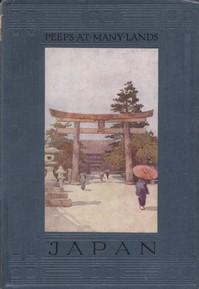
Peeps at Many Lands: Japan — Text and Context
(0 User reviews)
214
Project Gutenberg
2005
Not confirmed
Japan -- Description and travel
Readers of public-domain and historical texts
Project Gutenberg digital edition
en
Edition facts
Words
26,208
Reading time
114 min
Text sections
3
The catalog record for Peeps at Many Lands: Japan — Text and Context provides practical reading context through 26,208 words, 1 hr 54 min estimated reading time, and 3 detected text sections.
The text analysis averages about 23.6 words per sentence, while the detected sections provide another way to judge how the source is divided.
Project Gutenberg metadata also associates the work with “Japan -- Description and travel,” connecting these edition facts with the source record’s subject description.
Source:
Project Gutenberg record #7936
John Finnemore's 1905 travelogue introduces Japanese life through domestic routines, festivals, and kite-flying, framed by a British imperial perspective that compares Japan to England.
Editorial Edition Score
4.6/5
★★★★★
★★★★★
Calculated from edition completeness, EPUB availability, text structure and catalogue metadata. Not a user rating.
How this score is calculated
- Description quality20 pts
- Title & short description10 pts
- Source metadata20 pts
- Text length15 pts
- Chapters / structure15 pts
- EPUB file integrity20 pts
Total of 100 points, scaled to a 2.5-5.0 range. Editions with an empty description or a missing EPUB file are not scored.
Edition quality
Read the Text
I. THE LAND OF THE RISING SUN
II. BOYS AND GIRLS IN JAPAN
III. BOYS AND GIRLS IN JAPAN (_continued_)
VII. IN THE HOUSE (_continued_)
IX. A JAPANESE DAY (_continued_)
XI. THE FEAST OF DOLLS AND THE FEAST OF FLAGS
XII. A FARTHING'S WORTH OF FUN
XV. TEA-HOUSES AND TEMPLES
XVI. TEA-HOUSES AND TEMPLES (_continued_)
XVII. THE RICKSHAW-MAN
XVIII. IN THE COUNTRY
XIX. IN THE COUNTRY (_continued_)
XX. THE POLICEMAN AND THE SOLDIER
XXI. TWO GREAT FESTIVALS
LIST OF ILLUSTRATIONS
_Sketch-Map of Japan_
OFFERING TEA TO A GUEST
PEACH TREES IN BLOSSOM
THE TORII OF THE TEMPLE
THE LAND OF THE RISING SUN
Far away from our land, on the other side of the world, lies a group of islands which form the kingdom of Japan. The word "Japan" means the "Land of the Rising Sun," and it is certainly a good name for a country of the Far East, the land of sunrise.
The flag of Japan, too, is painted with a rising sun which sheds its beams on every hand, and this flag is now for ever famous, so great and wonderful have been the victories in which it has been borne triumphant over Russian arms.
In some ways the Japanese are fond of comparing themselves with their English friends and allies. They point out that Japan is a cluster of islands off the coast of Asia, as Britain is a cluster of islands off the coast of Europe. They have proved themselves, like the English, brave and clever on the sea, while their troops have fought as nobly as British soldiers on the land. They are fond of calling themselves the "English of the East," and say that their land is the "Britain of the Pacific."
The rise of Japan in becoming one of the Great Powers of the world has been very sudden and wonderful. Fifty years ago Japan lay hidden from the world; she forbade strangers to visit the country, and very little was known of her people and her customs.
Her navy then consisted of a few wooden junks; to-day she has a fleet of splendid ironclads, handled by men who know their duties as well as English seamen. Her army consisted of troops armed with two swords and carrying bows and arrows; to-day her troops are the admiration of the world, armed with the most modern weapons, and, as foes, to be dreaded by the most powerful nations.
Fifty years ago Japan was in the purely feudal stage. Her great native Princes were called Daimios. Each had a strong castle and a private army of his own. There were ceaseless feuds between these Princes and constant fighting between their armies of samurai, as their followers were called. Japan was like England at the time of our War of the Roses: family quarrels were fought out in pitched battle. All that has now gone. The Daimios have become private gentlemen; the armies of samurai have been disbanded, and Japan is ruled and managed just like a European country, with judges, and policemen, and law-courts, after the model of Western lands.
When the Japanese decided to come out and take their place among the great nations of the world, they did not adopt any half-measures; they simply came out once and for all. They threw themselves into the stream of modern inventions and movements with a will. They have built railways and set up telegraph and telephone lines. They have erected banks and warehouses, mills and factories. They have built bridges and improved roads. They have law-courts and a Parliament, to which the members are elected by the people, and newspapers flourish everywhere.
Japan is a very beautiful country. It is full of fine mountains, with rivers leaping down the steep slopes and dashing over the rocks in snowy waterfalls. At the foot of the hills are rich plains and valleys, well watered by the streams which rush down from the hills. But the mountains are so many and the plains are so few that only a small part of the land can be used for growing crops, and this makes Japan poor. Its climate is not unlike ours in Great Britain, but the summer is hotter, and the winter is in some parts very cold. Many of the mountains are volcanoes. Some of these are still active, and earthquakes often take place. Sometimes these earthquakes do terrible harm. The great earthquake of 1871 killed 10,000 people, injured 20,000, and destroyed 130,000 houses.
John Finnemore opens Peeps at Many Lands: Japan by positioning the country as a mirror of Britain: a cluster of islands off Asia, with a rising-sun flag and a recent military triumph over Russia. The first chapter swiftly contrasts the feudal Japan of fifty years earlier—Daimios, samurai, wooden junks—with the modern power that now commands ironclads and Western-style troops. This framing sets up a book that will oscillate between admiring Japanese customs and measuring them against British norms.
The excerpts that follow, however, shift focus from geopolitics to everyday life: children at a theatre, kite-flying competitions, and domestic routines. The reader should note that Finnemore’s lens is consistently that of an outsider explaining Japan to a young British audience, and his observations are filtered through that Edwardian sensibility.
A Child’s-Eye View of Entertainment
The chapter “A Farthing’s Worth of Fun” offers a rare glimpse of Japanese theatre through the eyes of children. Finnemore describes a performance lasting from six in the morning until eleven at night—a duration that astonishes even the young characters. The grandmother character remarks that a new government decree limits plays to nine hours, which she considers “too little.” This detail reveals both the cultural value placed on lengthy entertainment and the tension between tradition and modern regulation.
The children’s experience is tactile and communal: they sit in a box, gather scattered dishes, and retrieve their shoes from an attendant using a wooden ticket. Finnemore emphasizes the sensory richness—the fairground, the pots and pans, the slow walk home after spending their last coin. The passage avoids moralizing; it simply presents the theatre as a natural part of childhood, distinct from British norms but not exoticized.
Kite-Flying as Combat and Craft
Chapter XIII, “Kite-Flying,” is the most detailed excerpt and showcases Finnemore’s strength in describing physical action. The chapter opens with a holiday scene: men of sixty and toddlers of three all flying kites, including a baby with a scrap of kite on a string. The central event is Taro’s first flight of a fighting kite—a five-foot-square bamboo frame covered in tough paper. The day before, he pounded glass into glue and rubbed it on the string near the kite end, a preparation for cutting rivals’ cords.
The aerial battle that follows is described with precise verbs: the kites “fluttered, darted, swooped, dived.” Taro faces a boy named Kanaya, whose eagle-shaped kite challenges his own. The fight lasts over an hour, involving feints and dodges. Finnemore notes that every kite has its own “tricks of moving in the air,” implying a deep folk knowledge. The passage ends mid-battle, leaving the outcome unknown—a reminder that the excerpts are incomplete.
Domestic Life and the Role of Women
Though the excerpts focus on children at play, the book’s chapter list indicates substantial coverage of home life: “In the House,” “A Japanese Day,” and “The Japanese Girl.” The illustrations by Ella Du Cane—such as “The Little Nurse” and “Offering Tea to a Guest”—suggest that domestic scenes, particularly those involving women and children, are central to Finnemore’s portrait.
In the theatre excerpt, the grandmother figure is practical and authoritative, gathering dishes and managing the children. The kite-flying scene includes O Hara San, who carries a baby on her back while the toddler flies a kite. These glimpses hint at a society where women manage households and childcare even during leisure. Finnemore does not comment directly on gender roles, but the visual and textual evidence points to a structured domestic sphere that he presents without overt judgment.
The Imperial Frame: Britain as Yardstick
From the opening paragraph, Finnemore compares Japan to Britain: both are island nations, both have strong navies, and the Japanese call themselves “the English of the East.” This framing is not neutral; it reflects the Edwardian interest in Japan as an ally and a model of modernization. The book was published in 1905, shortly after the Russo-Japanese War, and Finnemore references “great and wonderful victories” that made the flag “for ever famous.”
Yet the domestic chapters avoid overt politics. The contrast between the opening’s grand narrative and the later focus on kite-flying and theatre suggests that Finnemore aimed to humanize Japan for young readers. The reader should be aware that the author’s perspective is that of a British outsider, and his comparisons—while often admiring—reinforce a hierarchy where British customs are the implicit norm. The excerpts do not include Japanese voices speaking for themselves; all observations are filtered through Finnemore’s prose.
These excerpts reveal a book that balances two purposes: to inform young British readers about a foreign culture and to entertain them with vivid scenes of childhood. Finnemore’s strength lies in concrete details—the glass-glued kite string, the nine-hour play, the wooden shoe ticket. Readers should approach the text as a period piece, mindful of its imperial context, and enjoy the specific observations of daily life that transcend the author’s biases. The incomplete excerpts leave many chapters unexplored, particularly those on festivals and the countryside, which may offer further contrasts.
That rainy afternoon, Finnemore’s Japan felt less like a travelogue and more like a quiet porch confession—kites tugging against a gray English sky. I kept thinking how place is never just scenery, but a mood you inherit. Later, almost by accident, I wandered into Normandy: The Scenery & Romance of Its Ancient Towns, Part 3 — A Reader’s Guide, and the same soft ache for old stones followed me there.
There are no reviews for this eBook.
There are no comments for this eBook.
Reader reflection
What did you think of this book?
Answer a few questions and save a private reflection on this device.
Your progress
0
/
10
2
How much did you enjoy the reading experience?
3
Would you recommend this book to another reader?
4
How easy was the book to follow?
5
How much did the book move you?
6
Did the book give you something worth debating?
7
Was the book what you thought it would be?
8
How clear did the writing feel?
9
What is the main idea you are taking away?
10